


Last Updated: October 26, 2026
Ask a marketing team how many software subscriptions it pays for and watch the room go quiet. Someone will open a spreadsheet that was last updated during a different administration. Someone else will remember a scheduling tool that a former coordinator signed up for on a free trial and that has, apparently, been billing a company card every month since. Nobody is lying. Nobody actually knows.
Marketing departments collect tools the way kitchen drawers collect takeout menus: one at a time, each for a perfectly good reason, until the drawer will not close. It is rarely a problem anyone sees as “IT,” which is exactly why it becomes one. When a business brings in outside help and asks us to audit its Calgary tech services and subscriptions, the security and cost leaks that worry me most are often not in the server room. They are in the design app, the email platform and the social scheduler that marketing set up on its own.
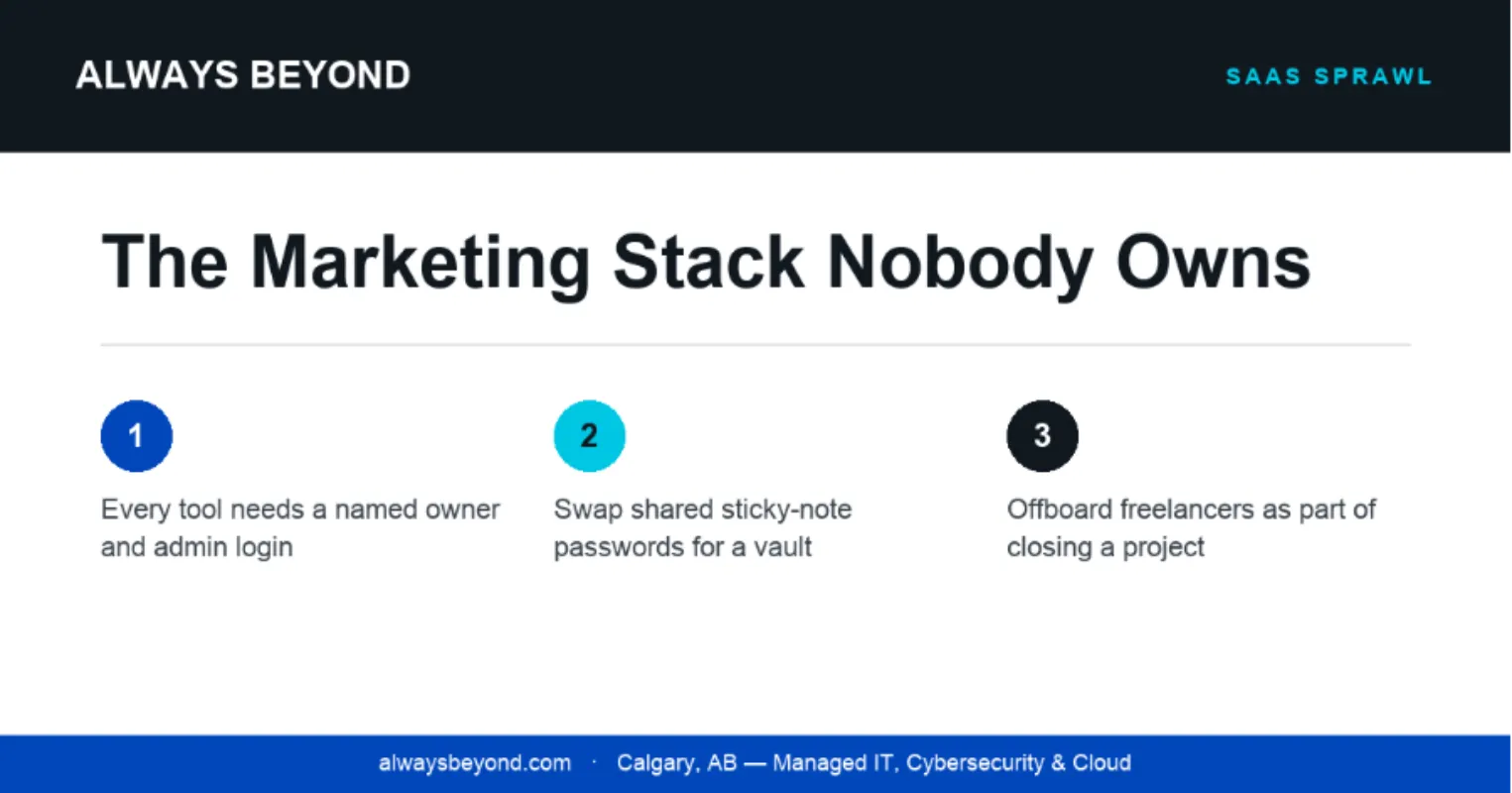
Every tool needs a name next to it
The root issue is not the number of subscriptions. Marketing genuinely needs a lot of specialised software, and a creative team forced onto one bland all-purpose tool will simply go around it. The issue is that each tool tends to be owned by whoever signed up first, which means it is owned by nobody once that person changes roles or leaves.
The fix is unglamorous. Keep a single list of every tool the team uses, and next to each one write three things: who owns it, which card pays for it and which login is the administrator. That last point matters more than it looks. If the admin account sits on a former employee’s email address, you do not really control that tool. You are borrowing it.
Once the list exists, the duplicates jump out on their own. Two design tools, three ways to schedule posts, a survey app used once for an event in the spring. Cancelling those is the easy, satisfying part.
The sticky note is not a password manager
Shared logins are the other half of the mess. Marketing work is collaborative and deadline-driven, so the path of least resistance is one account with one password, passed around in a group chat or, in offices I have actually walked through, written on a sticky note stuck to a monitor.
The trouble is that a shared password cannot be revoked for one person. When a contractor finishes their project, the only way to remove their access is to change the password for everyone, which nobody gets around to on a busy week. So it stays the same for a year.
A business password manager solves most of this without slowing anyone down. People get access to the logins they need, the passwords themselves can be long and unique, and removing someone takes a click. Where a tool supports single sign-on through your company accounts, use it, because then switching off one account switches off all of them. Pair either approach with multi-factor authentication on anything that touches money or public channels: your ad accounts, your social profiles and your email platform.
Who offboards the freelancer?
This is the question that tends to get a blank look. When a full-time employee leaves, there is usually a process, however patchy. When a freelance designer, an agency or a short-term contractor wraps up, there often is not. Their access to your ad accounts, your brand folder and your customer email list simply lingers.
Lingering access is not always malicious, but it is always a risk. A freelancer’s own account can be compromised, and suddenly someone you never hired has the keys to your social channels during a product launch.
Give every external collaborator their own login rather than a shared one, note the end date of the engagement on that master list, and make removing their access part of how a project closes, alongside the final invoice. Some teams make it a rule that nobody gets paid the last instalment until access has been handed back, which is blunt but effective.
Make one person care
None of this needs a big project. It needs one person on the marketing team who is responsible for the list, a short review every quarter and a habit of asking “who owns this?” before anyone clicks “start free trial.” Pick that person this week. The drawer will not close itself.